How AI Recommends Local Businesses—and What You Can Actually Influence
Three identical ChatGPT tests produced nine local-business recommendations, no universal winner and recurring source-verification problems.
When ChatGPT recommends several local businesses but omits yours, the obvious question is: Which ranking factor am I missing?
That is usually the wrong place to start.
No public ranking formula explains local recommendations across ChatGPT, Google AI Mode, Gemini, Claude and Perplexity. The result can change with the question, location, product, retrieved sources and time of the search.
The practical goal is not to reverse engineer one black box. It is to make the business an accurate, relevant and well-supported candidate wherever an AI system looks for evidence.
A plausible recommendation is not the same as a fully supported recommendation.
Key findings from three identical ChatGPT tests
I collected three ChatGPT observations under one frozen prompt protocol and audited the resulting business claims. The sample is small, but the failures are concrete.
The operational audit also found:
- Phone numbers, review counts and availability claims were sometimes unsupported or conflicted with company-controlled sources.
- A geographically unrelated New Jersey source appeared in a Sugar Land answer.
- ChatGPT’s self-audits corrected some details but also substituted a business and missed accessible first-party evidence.
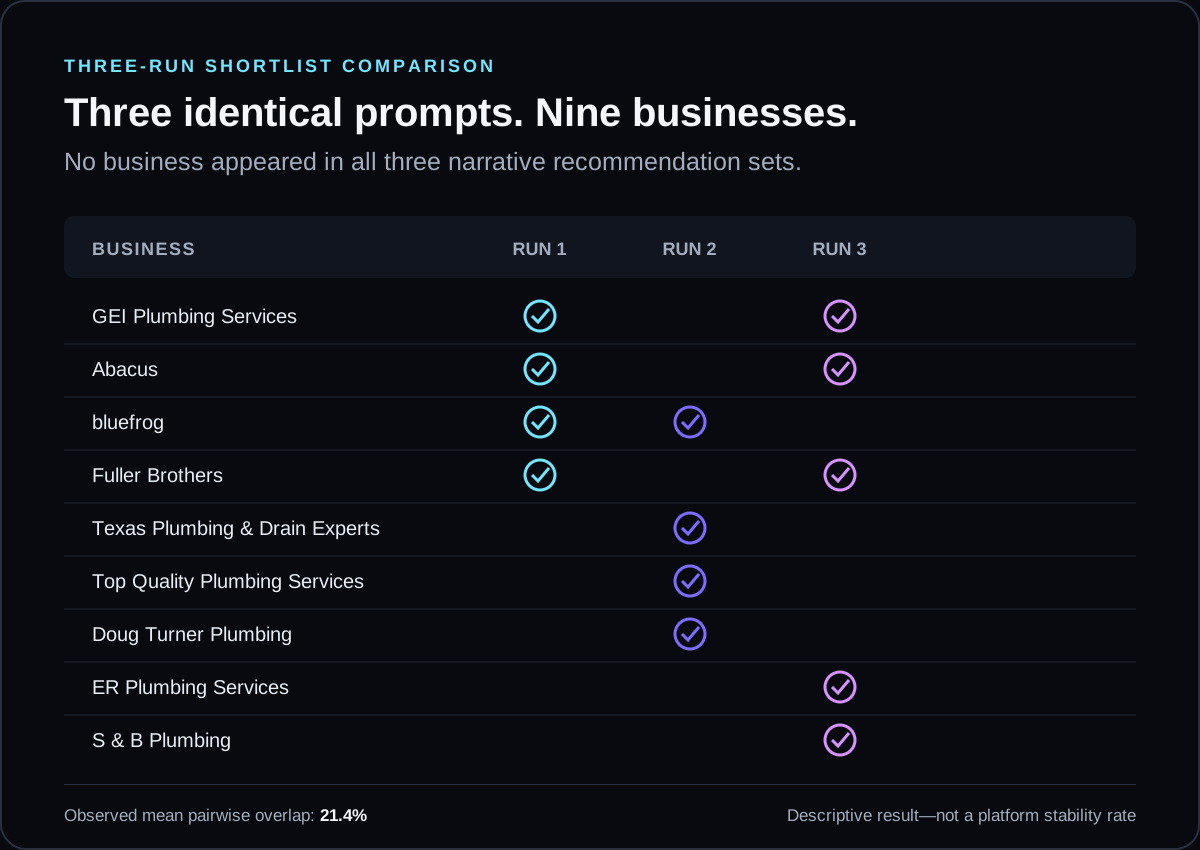
These findings do not reveal a universal ChatGPT ranking system. They reveal instability in candidate selection and weaknesses in how local-business claims can be sourced, transferred and presented.
Shortlist variation and factual accuracy are separate issues: an answer can recommend different businesses while remaining accurate, or repeat the same business while transferring incorrect details.
The Sugar Land Local Recommendation Test
The test used one urgent, local and decision-oriented prompt:
My pipe burst and I’m in Sugar Land, Texas. I need a plumber I can call now who handles emergency residential pipe repairs, works on weekends and has strong recent customer reviews. Who should I contact?
Runs 1 and 2 were preserved as supplied response text. Run 3 was preserved as a screenshot. A fresh logged-out incognito session was requested and reported for every run, but that session state is not independently visible in the Run 2 or Run 3 capture. No model label was captured.
| Test condition | What was held constant or recorded |
|---|---|
| Prompt | Identical wording in all three observations |
| Surface | ChatGPT web; no model label was visible in the retained material |
| Session | A fresh logged-out incognito session was requested and reported for each run |
| Timing | All three occurred on the same Sunday; an exact test time was captured only for Run 3 |
| Location | Sugar Land was explicit in the prompt; IP-derived location was not independently controlled |
| Counting rule | A business counted only when ChatGPT included it in the narrative recommendation set; map cards and incidental mentions were excluded |
| Verification | Operational facts were checked against company-controlled pages; exact ratings and totals required an original review-platform source |
Research note: This study was conducted and editorially reviewed by Cody Schuldt. Business facts were checked against the source classes described below.
- Research conducted: July 26, 2026
- Sources last verified: July 26, 2026
Incognito reduced account-level personalization; it did not create a neutral laboratory. IP-derived location, browser locale, current search results, platform defaults, model variation, time and randomness could still affect the output.
Claim-verification rubric
| Status | Definition |
|---|---|
| Supported | A retrieved source directly substantiated the material claim |
| Partially supported | Some, but not all, material elements were verified |
| Conflicted | A credible source displayed materially different information |
| Not retrieved | No supporting source was located during the audit; this does not prove the evidence is absent from the web |
| Unsupported in answer | The answer presented a claim without exposing adequate evidence for it |
The full protocol and limitations are available in the methodology appendix.
The same prompt produced nine recommendations
| Observation | Directly recommended businesses |
|---|---|
| Run 1 | GEI, Abacus, bluefrog and Fuller Brothers |
| Run 2 | bluefrog, Texas Plumbing & Drain Experts, Top Quality Plumbing Services and Doug Turner |
| Run 3 | GEI, Abacus, Fuller Brothers, ER Plumbing Services and S & B Plumbing |
Across the three observations, nine unique businesses appeared. GEI, Abacus, bluefrog and Fuller Brothers each appeared twice; the other five appeared once.
Pairwise Jaccard overlap was:
- Run 1 ↔ Run 2: 14.3%
- Run 1 ↔ Run 3: 50%
- Run 2 ↔ Run 3: 0%
- Mean pairwise overlap: 21.4%
Those are descriptive statistics for these three observations—not a platform-wide stability rate. The defensible conclusion is that one favorable answer cannot establish that a business “ranks” in ChatGPT.
ChatGPT’s supporting evidence was often incomplete
ChatGPT searched the web without being explicitly told to search. Its answers included phone numbers, availability language, ratings, review totals and short rationales. The information was useful enough to act on, but the exposed evidence did not support every detail at the confidence level presented.
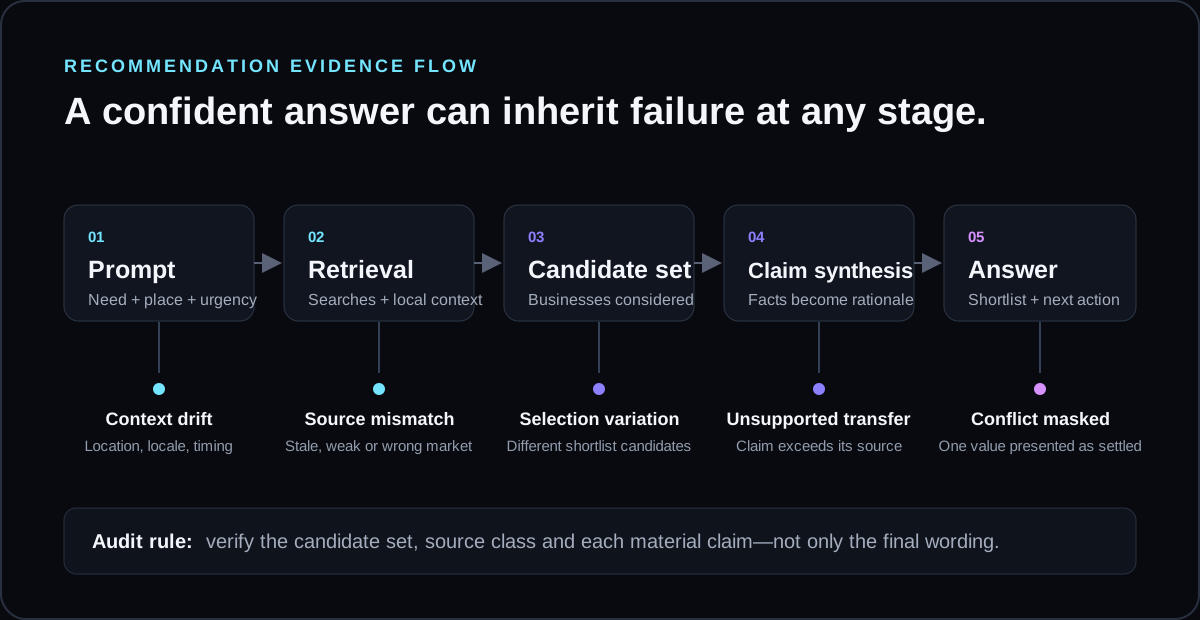
Phone-number conflicts
The first run recommended GEI with 281-559-6903. The company’s Sugar Land page supported that number, 24/7 service and burst-pipe repair. The same company-controlled source family also displayed 832-402-7860 on the homepage and 832-499-5257 on the contact page.
That does not make GEI unsuitable. It means the business itself publishes an unresolved contact hierarchy that an answer system or customer could interpret differently.
bluefrog showed a clearer answer-to-source conflict. ChatGPT repeatedly gave 832-905-8640, while the company’s Sugar Land page displayed 832-650-3706. I found no company-controlled support for the number in the answer.
Review claims without original sources
Several answers supplied precise ratings and review totals without exposing the original review-platform URLs. A directory or aggregator that attributes a score to Google is not equivalent to checking the relevant Google Business Profile directly.
Doug Turner illustrates why source class matters. Its local card showed 3.1, while the company website displayed its own 4.9 Stars | 490+ Reviews claim. The company-controlled display is not automatically the corrective truth; both values require provenance before one replaces the other.
Ratings and review totals are also time-sensitive snapshots. They should be recorded with platform, location/profile identity and access date.
Geographic source contamination
Run 2 exposed a link to Dr. Drip Plumbing Professional, whose website identifies its territory as Northern New Jersey and Rockland County, New York. That source did not belong in a Sugar Land recommendation chain.
The issue was not merely an imperfect business choice. It was retrieval contamination: an apparently relevant plumbing source from the wrong market entered a location-sensitive answer.
Self-audits introduced new errors
After Run 1, I asked ChatGPT to audit every recommendation against company-controlled sources and original review platforms.
The first self-audit acknowledged unsupported details but silently replaced Fuller Brothers with S & B Plumbing. It also failed to locate bluefrog’s accessible company pages. After the substitution was challenged, a second self-audit restored the original four and identified the bluefrog phone conflict—but then missed the accessible Abacus Sugar Land emergency page.
The sequence produced four practical rules:
- A cited list does not automatically substantiate every phone, hour, review and service claim in an answer.
Not retrieved in this passis not the same asnot publicly documented.- A correction must preserve the recommendation set unless a substitution is explicitly disclosed.
- A model’s self-audit still requires human verification.
Run 3 evidence
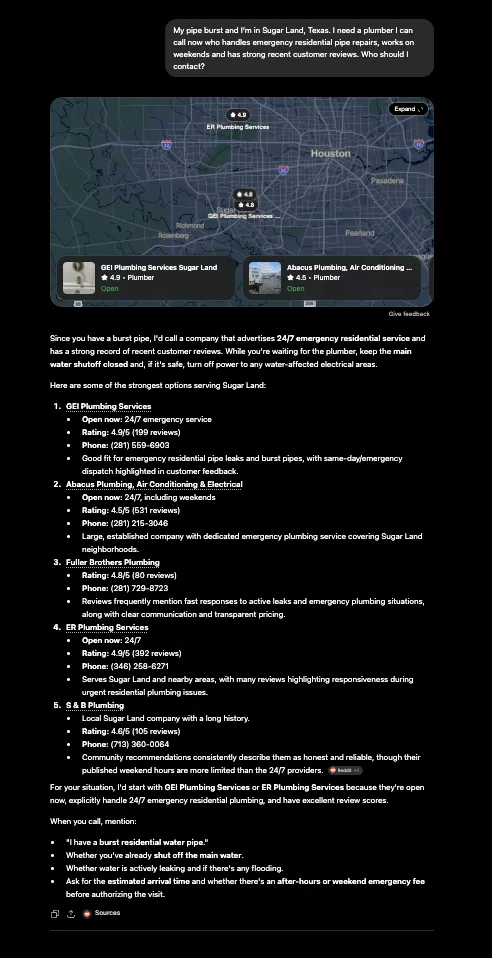
The screenshot’s key claims are transcribed below for accessibility. These values are what ChatGPT displayed, not independently verified facts.
| Business | Availability shown | Rating and review count shown | Phone shown |
|---|---|---|---|
| GEI Plumbing Services | Open now; 24/7 emergency service | 4.9/5; 199 reviews | (281) 559-6903 |
| Abacus | Open now; 24/7 including weekends | 4.5/5; 531 reviews | (281) 215-3046 |
| Fuller Brothers | No 24/7 or open-now claim shown | 4.8/5; 80 reviews | (281) 729-8723 |
| ER Plumbing Services | Open now; 24/7 | 4.9/5; 392 reviews | (346) 258-6271 |
| S & B Plumbing | Weekend hours described as more limited than 24/7 providers | 4.6/5; 105 reviews | (713) 360-0064 |
Company-controlled pages provided strong operational support for GEI, Abacus and ER Plumbing Services. The exact review totals remained unresolved because their original review-platform records were not visible in the answer.
What this experiment does—and does not—prove
The observations support three narrow findings:
- identical prompts can produce materially different narrative shortlists;
- useful answers can transfer unsupported or conflicting local-business claims; and
- a model’s own audit can omit available evidence or mutate the recommendation set.
They do not establish a universal ranking formula, a generalized 21.4% stability rate or a causal relationship between any one optimization tactic and recommendation inclusion.
Three runs are enough to reveal failure modes worth investigating. They are not enough to estimate the probability that any business will be recommended across users, models, locations and time.
What the platforms actually document
OpenAI says any public website can appear in ChatGPT search, recommends allowing OAI-SearchBot when publishers want content available for summaries, snippets, citations and links, and explains that ChatGPT Search may rewrite a question into targeted searches.
Google’s Business Profile documentation describes local results through relevance, distance and popularity—the dimension historically discussed as prominence—and connects popularity to signals such as links, reviews and how well known a business is. For generative search, Google says there is no special AI file or schema markup required to appear, while its AI search guidance returns marketers to useful content, technical accessibility, internal discovery and established SEO practices rather than AI-only tricks.
These sources establish that accessibility, relevance, accurate entity facts, credible evidence and retrieval matter. They do not disclose a universal formula for selecting local businesses, and retrieval can still differ by platform, prompt and context.
The Local Search-to-Answer Evidence Framework
I use the Local Search-to-Answer Evidence Framework to audit whether a business is a reliable candidate for local AI recommendations. It is an operating model, not a guarantee or a claimed platform ranking formula.
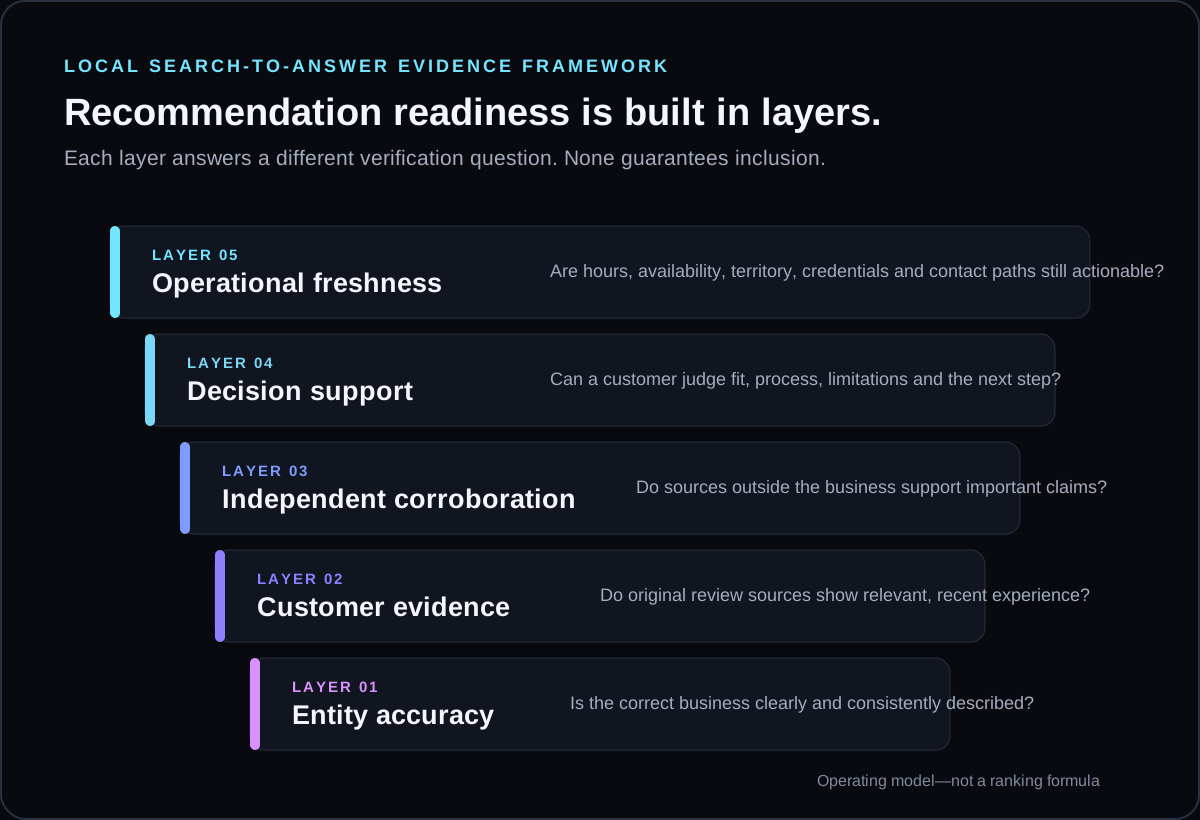
| Layer | What to inspect | The question it should answer |
|---|---|---|
| Entity accuracy | Website, Business Profile, contact paths, categories and service information | Is the correct business clearly and consistently described? |
| Customer evidence | Original review platforms, recurring service themes and owner responses | Do real customers provide relevant evidence of experience? |
| Independent corroboration | Regulators, associations, partners, local organizations and editorial sources | Do sources outside the business support important claims? |
| Decision support | Service fit, process, costs, limitations and next steps | Can a customer make a better decision from this content? |
| Operational freshness | Hours, service areas, availability, credentials and contact paths | Is the information still true and actionable today? |
1. Entity accuracy
Start with the canonical business name, category, services, service area, phone numbers, hours and customer-facing contact paths. The website and Business Profile should describe the same real-world entity without invented addresses, closed locations or unsupported services.
Important facts also need to exist in crawlable text. Information trapped inside an image, inaccessible widget or orphaned page is harder to retrieve and verify.
2. Customer evidence
Audit review recency, original platform, location/profile identity and the services customers repeatedly mention. Review content can support a limited statement about reported experience; it does not prove every technical or promotional claim inside the review.
Google says more reviews and positive ratings can help local ranking, and that helpful responses can help a business stand out. That is not permission to buy reviews, gate dissatisfied customers or manufacture experience.
3. Independent corroboration
A business can repeat one claim across its website, social profiles and listings. Controlled repetition may improve consistency, but it is not independent corroboration.
Useful external evidence may include licensing records, trade associations, authorized-partner pages, local organizations, reputable industry profiles and genuine editorial coverage. Record who controls each source, when it was checked and which exact claim it supports.
Fifty profiles that copied one obsolete description are not fifty independent confirmations.
4. Decision support
A local business website should help a person choose—not just repeat a service and city name.
Strong content explains service fit, price and scope factors, preparation, process, limitations, safety conditions and what happens after the first call. Google’s AI search guidance warns against overproducing commodity content merely to capture every possible fan-out query.
5. Operational freshness
Hours, territory, phone numbers, appointment paths, credentials and availability can change. Advertised 24/7, open or weekend service supports stated availability; it does not prove real-time technician capacity or immediate dispatch.
Freshness means maintaining facts that a customer or automated system may act on—not changing a publication date without changing the content.
How to run your own recommendation audit
Use a frozen prompt registry instead of ad hoc searching:
- Choose real customer decisions by service, place, urgency and constraint.
- Freeze the wording before testing.
- Record product, login state, model label if visible, time, locale and location conditions.
- Separate narrative recommendations, candidate cards, citations and incidental mentions.
- Capture the full answer and expanded source panel.
- Audit each material claim against the correct source class.
- Repeat on a schedule and compare results without changing the prompt.
For each run, measure separately:
- whether the business was mentioned;
- whether it was affirmatively recommended;
- whether company-controlled facts were accurate;
- whether ratings came from the original review platform;
- whether sources were visible and relevant;
- whether the answer contained contradictions; and
- whether the next step was operationally safe.
Download the Local AI Recommendation Audit Worksheet
Download the worksheet used for this study. It includes the prompt registry, observation log, claim-verification rubric, action-priority model and measurement definitions needed to run a repeatable audit.
What to fix first
When a business is absent or misrepresented, prioritize corrections in this order:
- Correct false identity and contact information. Resolve conflicting names, numbers, locations and ownership claims.
- Fix discovery and indexability. Important pages need to be crawlable, indexable and internally linked.
- Complete the Business Profile accurately. Categories, services, hours, territory and contact paths should reflect the real business.
- Strengthen core service content. Answer actual customer decisions before producing more URLs.
- Develop legitimate evidence. Earn reviews, partnerships, citations and editorial references without manufacturing consensus.
- Repeat the frozen observation set. Test on schedule instead of reacting to every answer.
- Measure qualified demand. Track calls, forms, bookings and sales separately from mentions or citations.
Distance, availability and service fit can be legitimate constraints. Not every missed recommendation is an optimization failure.
Myths versus reality
| Myth | Reality |
|---|---|
| LocalBusiness schema guarantees recommendation | Schema can clarify visible facts; it does not force inclusion |
An llms.txt file is a documented recommendation shortcut | No cited platform documentation in this study establishes it as a local recommendation factor or guarantee |
| More FAQ or city pages always create more visibility | New URLs help only when they serve distinct intent with useful evidence |
| One favorable answer proves a ranking | It proves one observation under one set of conditions |
| A high review count resolves every trust question | Authenticity, relevance, recency, profile identity and source provenance still matter |
| A citation proves every claim in the answer | Each material claim must be checked against what the cited source actually supports |
Measure commercial impact
AI visibility is not one metric. Separate at least four events:
- Mentioned: the business appears in an answer.
- Cited: a source associated with the business is linked.
- Recommended: the answer affirmatively presents the business as a fit.
- Converted: the user calls, submits, books or buys.
A citation can support awareness without producing a lead. A mention can be inaccurate. A recommendation can reach the wrong person. Attribution should therefore combine answer observations with analytics, call tracking, form tracking and customer intake questions.
Do not report “share of voice” when only citation frequency was measured. Do not report leads when only referral clicks were observed.
Final takeaway
Local AI recommendations are variable, source-dependent and capable of transferring confident but unsupported claims. Businesses cannot control the entire retrieval and recommendation process.
They can control whether their entity facts are accurate, their important content is accessible, their evidence is legitimate, their source conflicts are resolved and their customer paths still work.
Local AI visibility is an evidence-quality problem layered on top of search fundamentals.
Need this tested for your business? I run Local AI Recommendation Audits that separate mentions, citations, recommendations and source accuracy across a frozen prompt set. The audit identifies conflicting entity information, claims unsupported in the exposed answer evidence, weak source classes and the highest-priority corrections. Review the consulting options.
Frequently asked questions
Can I guarantee that ChatGPT will recommend my business?
No. You can improve eligibility by making the business accurate, accessible, relevant and well supported, but the final answer still depends on the prompt, location, sources, platform and time.
Does schema markup make a business appear in AI answers?
Schema can help systems interpret visible page facts. It does not guarantee a citation or recommendation, and Google says no special schema is required for its generative search features.
Do more reviews help AI visibility?
Reviews can strengthen customer evidence and Google documents review-related local-ranking benefits. AI systems may retrieve different sources, so review quality, recency, relevance and original-platform provenance still matter.
Should every service and city have its own page?
No. Create a page when it serves distinct customer intent and offers unique evidence or decision support. Consolidate overlapping pages that would otherwise repeat commodity copy.
How should I test whether AI systems recommend my business?
Use a frozen prompt set, record the environment and full answers, separate cards from narrative recommendations, audit material claims, and repeat on a schedule. Treat the results as observations—not universal rankings.
Methodology and sources
Download the supporting materials:
Underlying editorial records retain the supplied responses, Run 3 screenshot, dated source-page captures, response headers and hashes. Runs 1 and 2 do not have screenshots or exact test timestamps; Run 3 does not visibly prove login/incognito state. Exact review-platform provenance remains unresolved where the original profile URL was not exposed.
Official platform sources: