Framework by Cody Schuldt

The Search-to-Answer Visibility System.

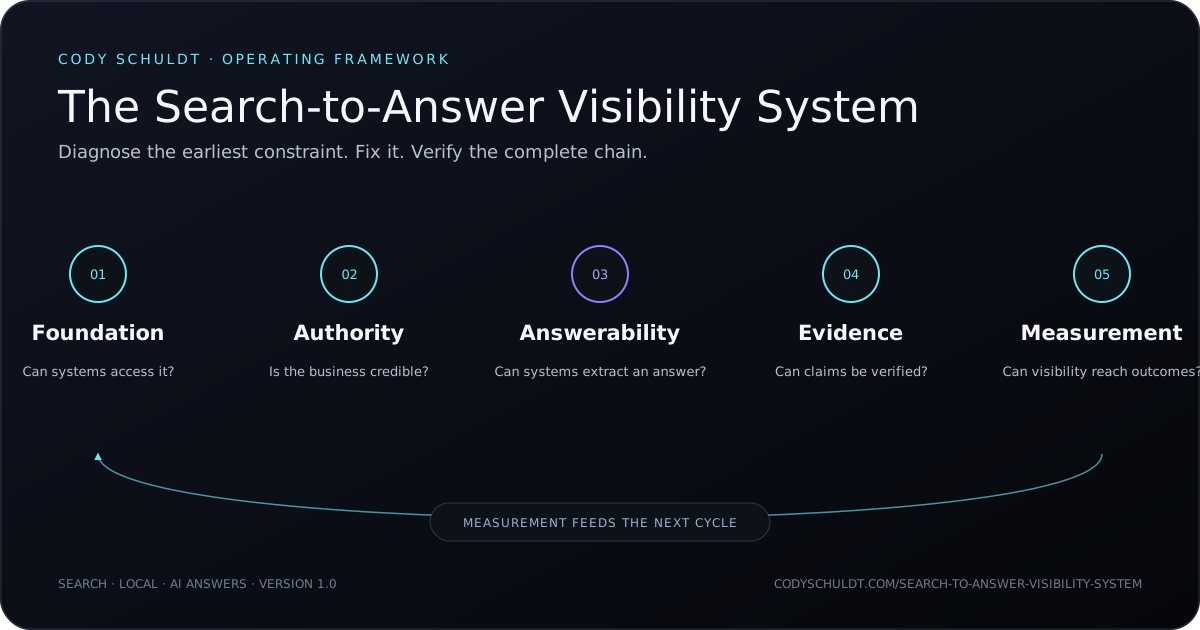
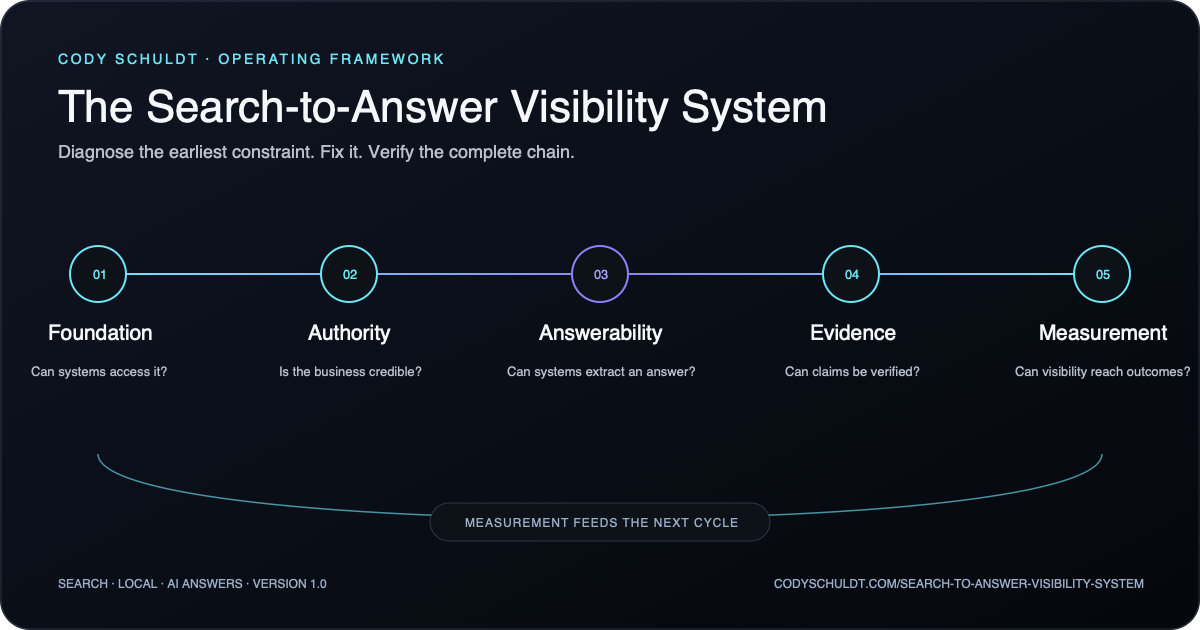
The Search-to-Answer Visibility System is a five-stage framework for diagnosing how a business becomes discoverable, understandable, verifiable, recommendable and measurable across search engines and AI platforms.

Operating principle: diagnose the earliest broken condition before prescribing content, schema, links, citations or reporting.

Developed byCody SchuldtSEO director and search visibility consultant

Version
1.0
First published
July 24, 2026
Last updated
July 24, 2026
The operating sequence Diagnose → fix the earliest constraint → verify the complete chain.
  1. 01
    FoundationCan systems access, crawl, index and interpret the right information?
  2. 02
    AuthorityDoes the business demonstrate topical and entity-level credibility?
  3. 03
    AnswerabilityCan systems extract a clear, relevant and useful answer?
  4. 04
    EvidenceAre material claims supported by reliable first- and third-party signals?
  5. 05
    MeasurementCan visibility be connected to behavior, demand, leads and attributed revenue signals?

Measurement feeds the next diagnostic cycle. The system is a loop, not a one-time checklist.

How to use it

Start with the constraint—not the tactic.

The stages are ordered for diagnosis. Teams can work across several at once, but downstream improvements rarely compensate for a serious upstream break.

  1. 01

    Baseline the journey

    Record current search retrieval, AI answer presence, source coverage and customer outcomes for a stable set of queries and prompts.

  2. 02

    Find the earliest break

    Diagnose the first weak stage in the chain. A downstream symptom often starts with an upstream Foundation or Authority gap.

  3. 03

    Sequence the work

    Fix the constraint before adding more content, schema, citations or reporting that cannot compensate for it.

  4. 04

    Repeat the same panel

    Recheck the same engines, markets, prompts and conversion signals so movement can be compared instead of guessed.

Five connected conditions

What each stage controls.

01

Foundation

Make the right pages, profiles and facts technically available to search and answer systems.

Diagnostic question

Can systems access, crawl, index and interpret the right information?

Work
Technical accessibility, information architecture, canonical signals, internal pathways and content quality.
Evidence of progress
Priority URLs are indexable, retrievable and aligned to the queries and markets they are meant to serve.
02

Authority

Establish clear subject ownership through topical depth, entity clarity and credible associations.

Diagnostic question

Does the business demonstrate topical and entity-level credibility?

Work
Expert content, entity consistency, market relevance, authorship and meaningful external associations.
Evidence of progress
The brand appears across the sources, topics and category conversations that shape consideration.
03

Answerability

Express expertise so a person or system can extract a direct answer without reconstructing the meaning.

Diagnostic question

Can systems extract a clear, relevant and useful answer?

Work
Question mapping, concise explanations, decision criteria, supporting context and structured presentation.
Evidence of progress
Priority questions have explicit answers with enough context to use them correctly.
04

Evidence

Support important claims with proof beyond repeated statements on the owned website.

Diagnostic question

Are material claims supported by reliable first- and third-party signals?

Work
Reviews, citations, primary records, expert references, customer proof and independent corroboration.
Evidence of progress
Material claims are supported by sources with clear provenance rather than controlled repetition alone.
05

Measurement

Track the full chain from retrieval and answer visibility to qualified customer action.

Diagnostic question

Can visibility be connected to behavior, demand, leads and attributed revenue signals?

Work
Stable query and prompt panels, source tracking, analytics, lead quality and commercial reporting.
Evidence of progress
The team can compare visibility over time and connect changes to qualified demand without overstating causation.
One system, different jobs

SEO, AEO and GEO solve different parts of the same visibility problem.

These disciplines overlap. They are not isolated channels, and none of them compensates for a broken visibility chain on its own.

01

SEO

Improves access, relevance, authority and visibility in traditional search systems.

SEO contributes across the system, with its strongest influence in Foundation and Authority through technical access, site architecture, useful content and competitive search performance.

02

AEO

Improves information clarity so systems can extract and present direct answers.

AEO concentrates on Answerability: concise responses, decision support, structured information and enough context to keep extracted answers accurate and useful.

03

GEO

Improves how a brand or source can be retrieved, evaluated, cited and recommended in generative experiences.

GEO coordinates Authority, Answerability and Evidence, then measures brand and source visibility across variable AI-generated answers. It does not replace SEO.

Search-to-Answer Visibility Assessment

Identify the weakest stage.

Answer all five questions. When more than one stage is weak, the assessment returns the earliest constraint in the operating sequence.

01FoundationCan systems access, crawl, index and interpret the right information?
02AuthorityDoes the business demonstrate topical and entity-level credibility?
03AnswerabilityCan systems extract a clear, relevant and useful answer?
04EvidenceAre material claims supported by reliable first- and third-party signals?
05MeasurementCan visibility be connected to behavior, demand, leads and attributed revenue signals?
Recognizable symptoms

The visible symptom is rarely the underlying problem.

A symptom can implicate several stages. Diagnosis starts by testing the earliest condition rather than assuming the latest tactic failed.

“We rank, but AI tools rarely mention us.”

Authority · Answerability · Evidence

Ranking proves some search visibility. It does not show that the brand is strongly associated, easy to quote or independently supported.

“AI platforms mention us but cite competitors.”

Answerability · Evidence

The brand may be recognized while clearer or better-corroborated sources supply the facts used in the answer.

“We have hundreds of pages but weak topic association.”

Foundation · Authority

Volume cannot compensate for unclear architecture, overlapping intent or a weak connection between the entity and the category.

“Our content answers questions but lacks independent credibility.”

Evidence

Owned copy can express a claim, but controlled repetition is not the same as external verification.

“Traffic is stable, but branded demand is falling.”

Authority · Measurement

Stable visits can hide weakening category salience, recommendation presence or commercial contribution.

“Our dashboards show visibility, but no one can connect it to revenue.”

Measurement

Rankings, mentions and citations remain leading observations until they are connected to qualified behavior and attributed outcomes.

Illustrative walkthrough

One symptom can come from five different constraints.

Hypothetical example: a plumbing company is not recommended in AI answers. This is a diagnostic illustration—not a client case study or performance claim.

01

Foundation

Priority service-area pages are blocked, duplicated or absent from the index.

02

Authority

The company has thin plumbing-topic coverage and weak local category associations.

03

Answerability

Pages do not clearly explain services, pricing factors, qualifications or what happens next.

04

Evidence

Important claims are not supported by reviews, licenses, completed-work proof or independent references.

05

Measurement

The company tracks rankings but not AI mentions, assisted conversions, calls or branded demand.

The model is not limited to local businesses. A SaaS company can use the same sequence to diagnose technical discovery, category association, comparison-ready answers, third-party validation and pipeline attribution.

Measurement framework

Measure the chain, not one screenshot.

Use a stable panel of queries and prompts. Record the engine, date, locale, device, login state, exact wording, cited URLs and factual accuracy, then connect platform observations to customer behavior. AI answers are variable; isolated outputs are observations, not trends.

LayerSignalsDecision
Search retrievalRankings, indexation, share of search and source coverageCan the brand be found?
Answer visibilityMentions, citations, recommendations and factual accuracyIs the brand used correctly in answers?
Evidence strengthReview depth, corroborating sources and entity consistencyCan the material claims be verified?
Commercial impactQualified visits, leads, pipeline and attributed revenue signalsDoes visibility contribute to demand?

Leading indicators

Signals that the visibility chain is becoming stronger.

  • Crawlability and indexation
  • Entity consistency
  • Topic coverage
  • Answer extraction
  • Source inclusion
  • Mentions and citations
  • Recommendation frequency

Lagging indicators

Business outcomes that should be evaluated over time.

  • Branded search
  • Qualified organic traffic
  • Assisted conversions
  • Calls and leads
  • Pipeline contribution
  • Attributed revenue signals
Operating impact

How the framework changes the work.

Strategy

Prioritize the earliest weak condition rather than a channel checklist.

Execution

Coordinate technical, content, entity, PR, local and conversion work against one diagnosis.

Reporting

Organize metrics by stage and connect them to qualified commercial outcomes.

Governance

Document what is being tested, why it matters and what evidence would justify changing direction.

Download and reuse

Take the framework into the room.

Use the visual in workshops, proposals and presentations. Attribute it to Cody Schuldt and link to this canonical framework page when publishing or sharing it.

Editable diagramSVG · scalable vector Shareable imagePNG · 1200 × 630 Landscape frameworkPDF · presentation-ready Presentation slidePPTX · editable labels Diagnostic worksheetPDF · printer-friendly
Methodology and use

Method, version and application.

Version 1.0 · First published July 24, 2026 · Last updated July 24, 2026 · Cody Schuldt

Method note

The framework synthesizes technical SEO, local-search, content-design, entity and visibility-measurement practices into one diagnostic sequence. It is designed for diagnosis and planning, not as a model of proprietary search-engine or language-model algorithms.

AI-answer observations should use a stable prompt panel and record the engine, date, locale, device, login state, exact prompt and cited sources. Outputs vary; isolated responses are not trends.

Preferred citation: Schuldt, Cody. The Search-to-Answer Visibility System, version 1.0 (2026). https://www.codyschuldt.com/search-to-answer-visibility-system

References and notes

These first-party sources provide context for technical access, structured information and citation behavior. They do not validate or endorse this framework.

  1. Google Search Central: AI features and your website Official guidance connecting AI-feature eligibility to established search fundamentals and technical access.
  2. Google Search Central: Introduction to structured data markup Official explanation of structured data as a standardized way to classify page information.
  3. OpenAI Help Center: ChatGPT Search First-party documentation describing search responses and source citations in ChatGPT.

Application paths

Businesses can use the system to prioritize fragmented visibility work. Agencies can use it to standardize audits, roadmaps and reporting without treating every symptom as a content problem.

What this system is not

A diagnostic model—not a ranking formula. It does not guarantee rankings, mentions, citations, recommendations or revenue. It does not turn controlled repetition into independent proof or claim to represent proprietary platform algorithms. It creates a consistent way to decide what to inspect, what to fix and what evidence should change next.
Framework FAQ

Questions about applying the system.

Is the Search-to-Answer Visibility System a ranking-factor model?

No. It is a diagnostic and operating framework for finding constraints across search and AI visibility. It does not claim to describe proprietary search-engine or language-model algorithms.

How is GEO different from SEO?

SEO improves technical access, relevance, authority and visibility in traditional search. GEO extends the work into generative experiences, where retrieval, source selection, citation and recommendation also need to be observed. The disciplines overlap; they are not isolated channels.

Does the framework apply only to local businesses?

No. The five conditions can be adapted to local and multi-location businesses, SaaS companies, professional services, publishers and agencies. The evidence and commercial signals change by market, but the diagnostic sequence remains useful.

How is each stage measured?

Foundation uses access and retrieval signals; Authority uses topic, entity and external-association signals; Answerability uses extraction and factual-use tests; Evidence uses corroboration and provenance; Measurement connects those observations to qualified behavior and commercial outcomes.

Can one business have multiple broken stages?

Yes. Several stages can be weak at once. The system starts with the earliest material constraint because downstream tactics rarely compensate for a serious upstream break.

How often should the framework be reassessed?

Reassess on a regular reporting cadence and after major site, market or platform changes. Use the same query and prompt panel where possible so movement is comparable.

Is AI visibility stable enough to measure?

Individual answers are variable. Measurement becomes more useful when teams repeat a stable prompt set across defined engines, dates, locales, devices and account states, then evaluate trends instead of treating one screenshot as proof.

Apply the framework

Find the weakest stage in your visibility system.

I’ll evaluate where your search-to-answer chain is breaking and recommend the highest-impact next steps.

Download the framework
Request a Visibility Diagnostic